1.Introduction#
The federal budget is not merely an accounting document—it is a statement of national priorities. Every appropriation reflects a choice about what government should do and for whom. Over the past five decades, Americans have grown increasingly divided not just about specific spending levels, but about the fundamental question of government's role in society.
This article examines partisan polarization in federal spending preferences using data from the General Social Survey (1972-2024). We analyze 22 outcomes covering national spending priorities (education, health, defense, welfare, environment, and more) and philosophical questions about government intervention. Our analysis reveals how Democrats and Republicans have sorted into opposing camps on questions that were once relatively bipartisan.
Data and Methods
We use survey-weighted estimates from the General Social Survey, analyzing trends among self-identified Democrats and Republicans. All estimates include 95% confidence intervals accounting for complex survey design. We track trends across nine presidential eras from Nixon/Ford through Biden.
2.The Current Landscape: 2024 Snapshot#
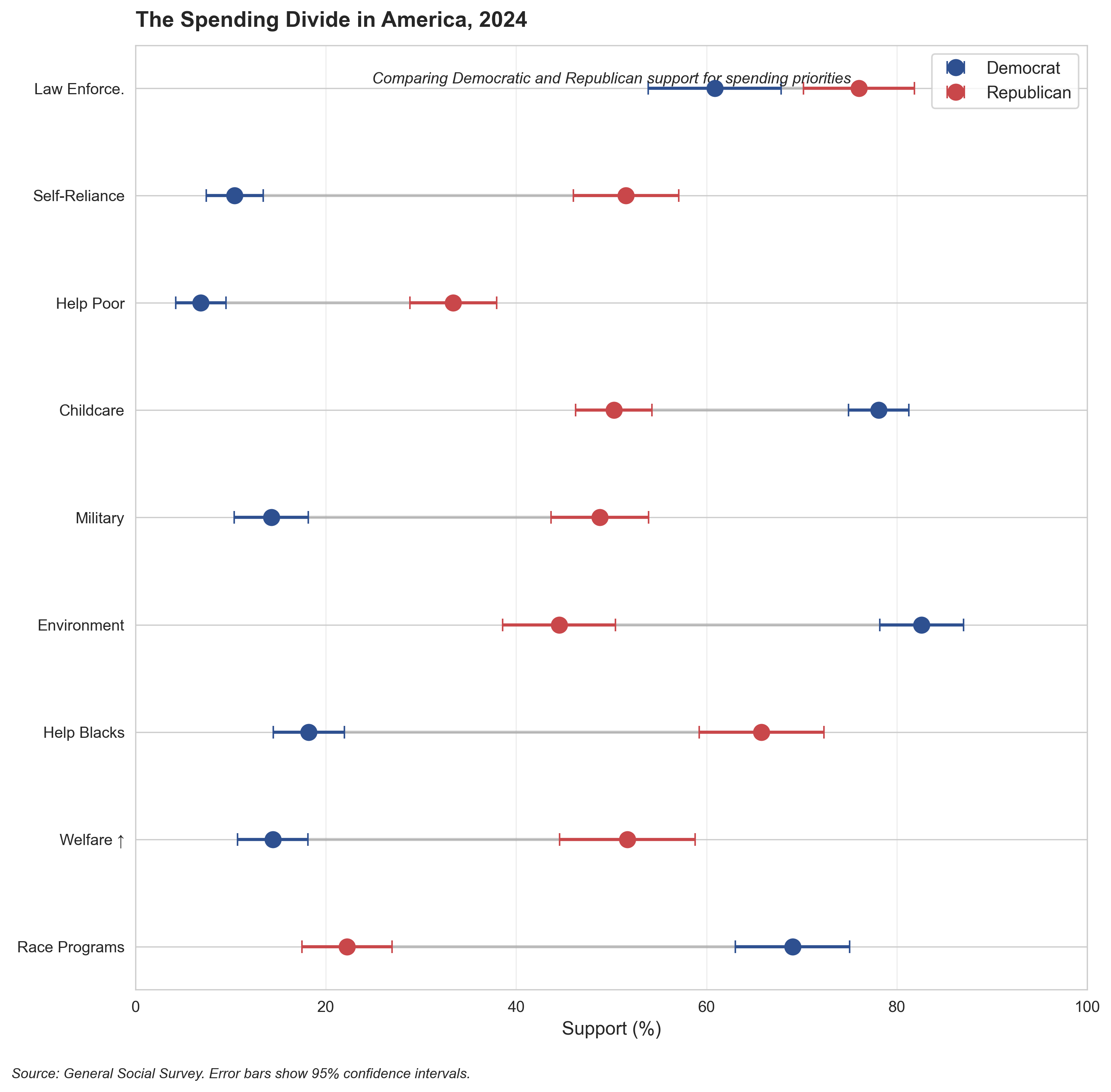
We begin with where we are today. Figure 1 shows partisan divides across ten key spending priorities and government role questions in 2024.
The landscape reveals sharp partisan sorting. On assistance to Blacks, the partisan gap exceeds 40 percentage points—Democrats are far more likely to support increased spending. Similarly large gaps emerge for income inequality reduction and welfare programs. Yet on some issues, bipartisan consensus remains: both parties support more spending on law enforcement and childcare assistance, though Democrats support them more strongly.
Education Amplifies the Divide#
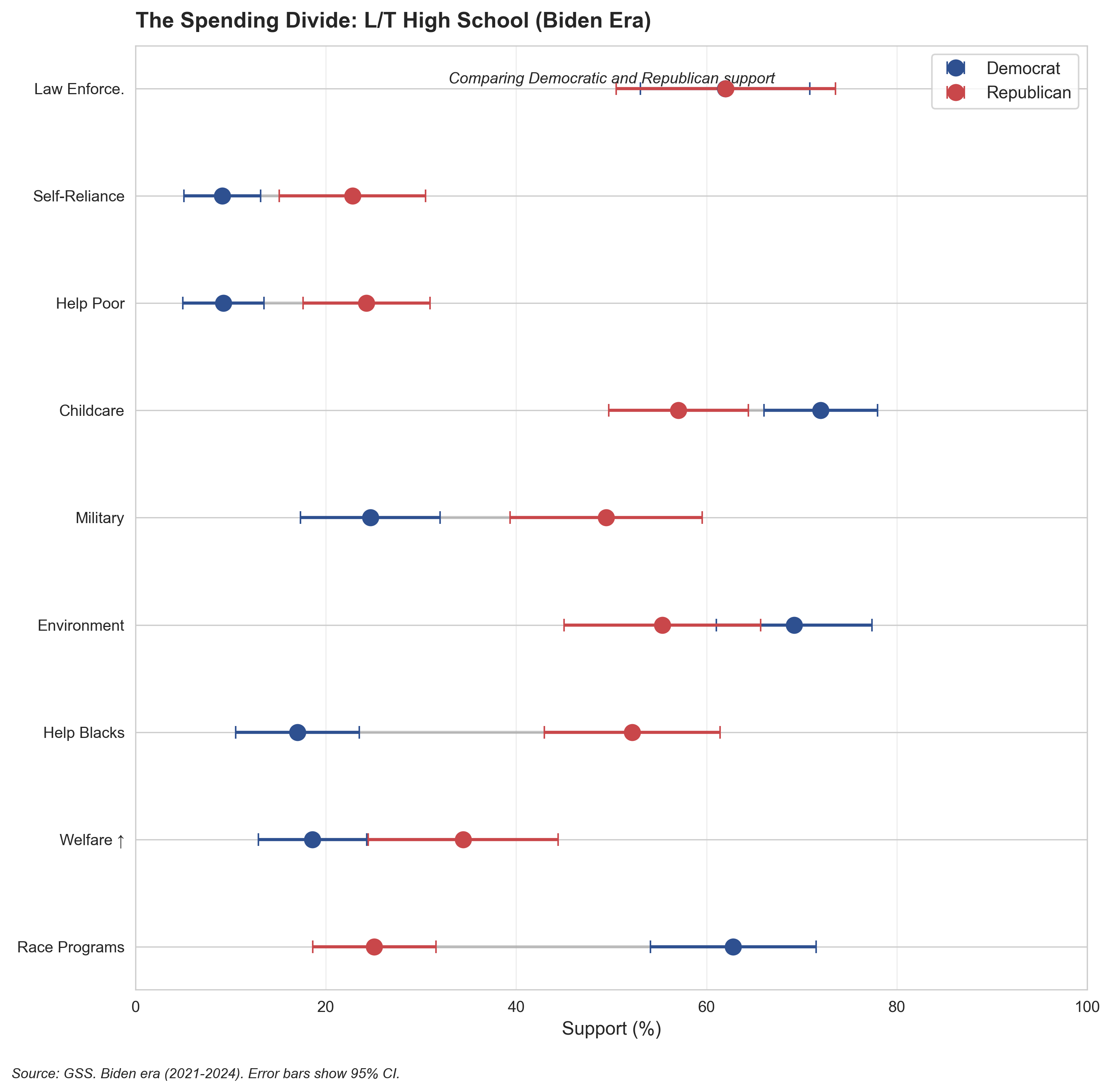
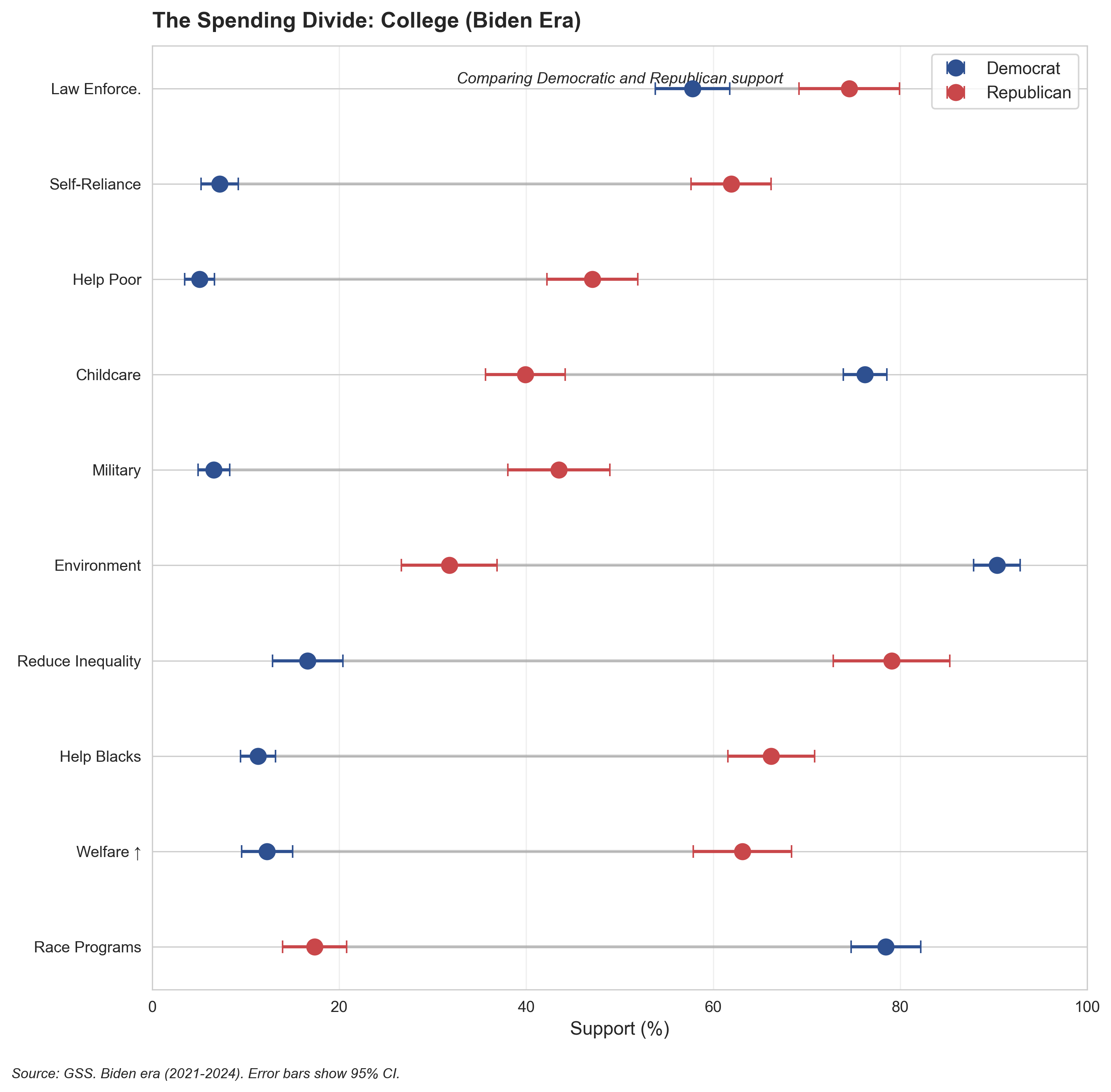
The 2024 snapshot varies dramatically by education level (Figures 2-3). Among those without college degrees, partisan gaps are substantial but not extreme. Among college graduates, the divides widen dramatically.
Education doesn't just correlate with partisanship—it amplifies it. College-educated Democrats are *more* supportive of government intervention than less-educated Democrats. College-educated Republicans are *less* supportive than less-educated Republicans. This pattern holds across most spending categories, suggesting that educational attainment now shapes not just what people know, but what they want government to do.
3.The Polarization Gradient: Not All Issues Polarize Equally#
Extreme Polarization: Race and Redistribution#
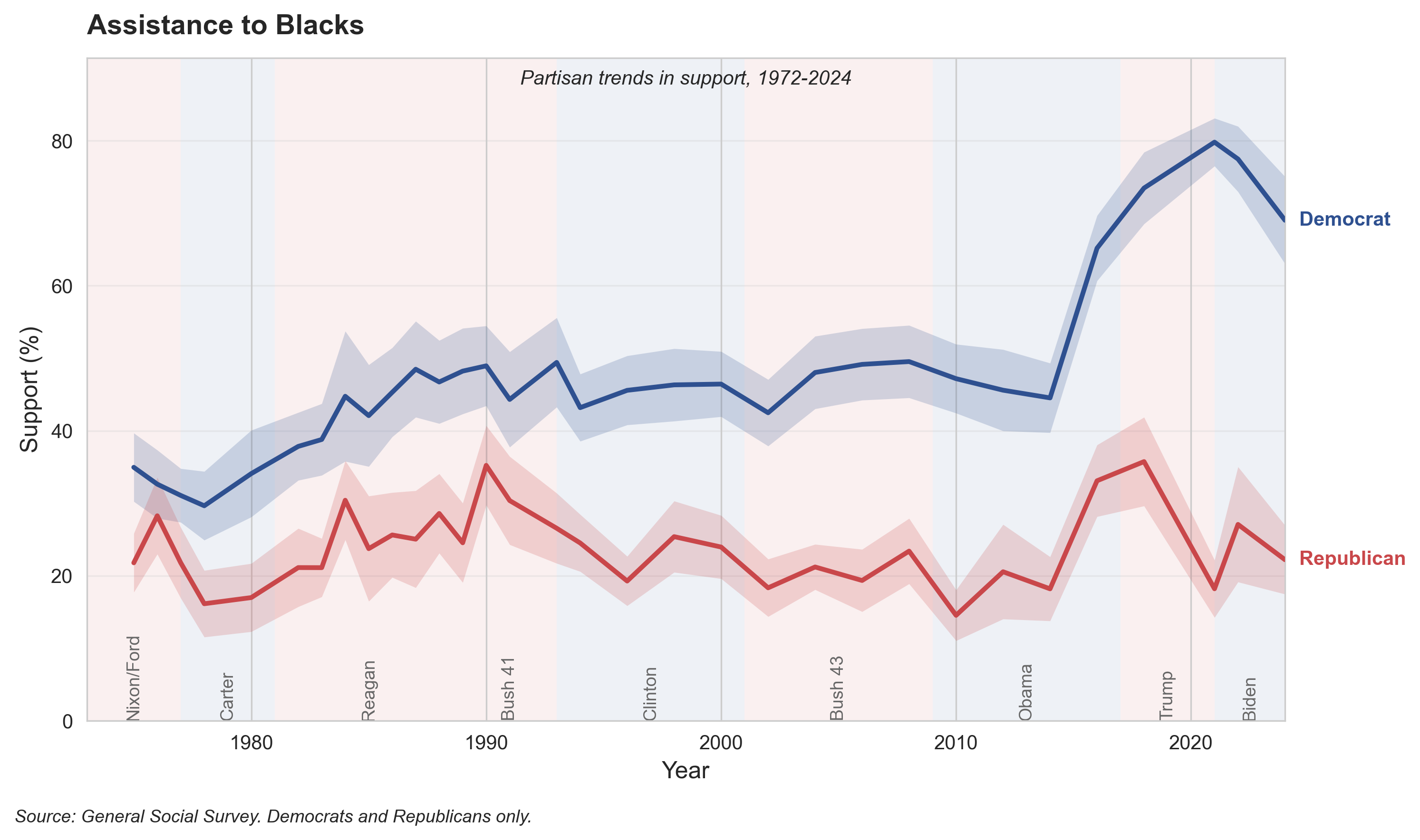
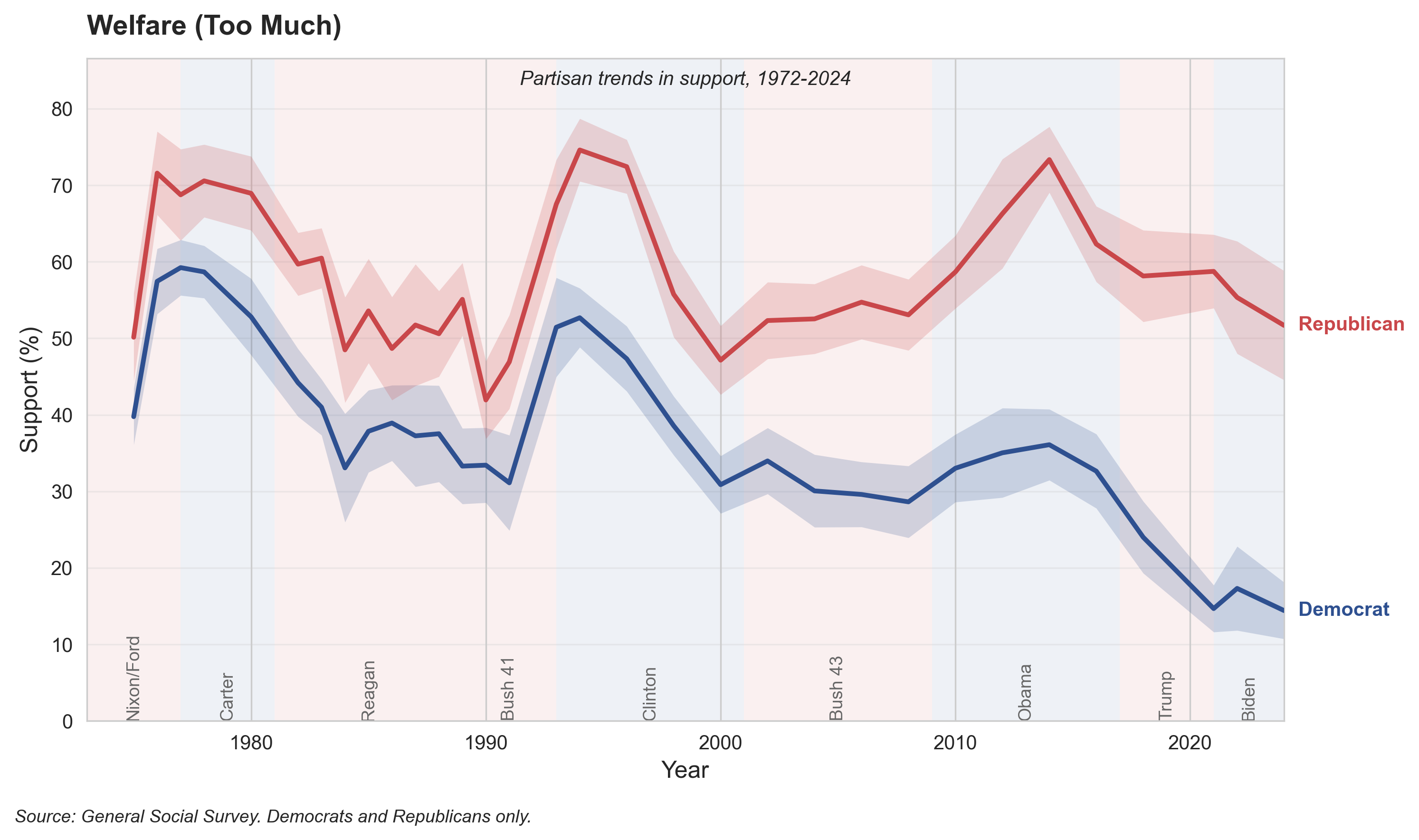
Some spending priorities have become lightning rods for partisan conflict. Consider assistance to Blacks (Figure 4) and welfare spending (Figure 5).
In the 1970s, about 35-40% of both Democrats and Republicans said we spent too little on "assistance to Blacks." By 2024, Democratic support has risen to nearly 60%, while Republican support has plummeted below 20%. This 40+ point gap represents one of the starkest partisan divides in American public opinion.
The welfare question shows the mirror image. When asked if we spend "too much" on welfare, Republicans have grown increasingly likely to say yes (now approaching 50%), while Democrats have become less concerned about excessive welfare spending (dropping to around 15%).
Moderate Polarization: Environment and Childcare#
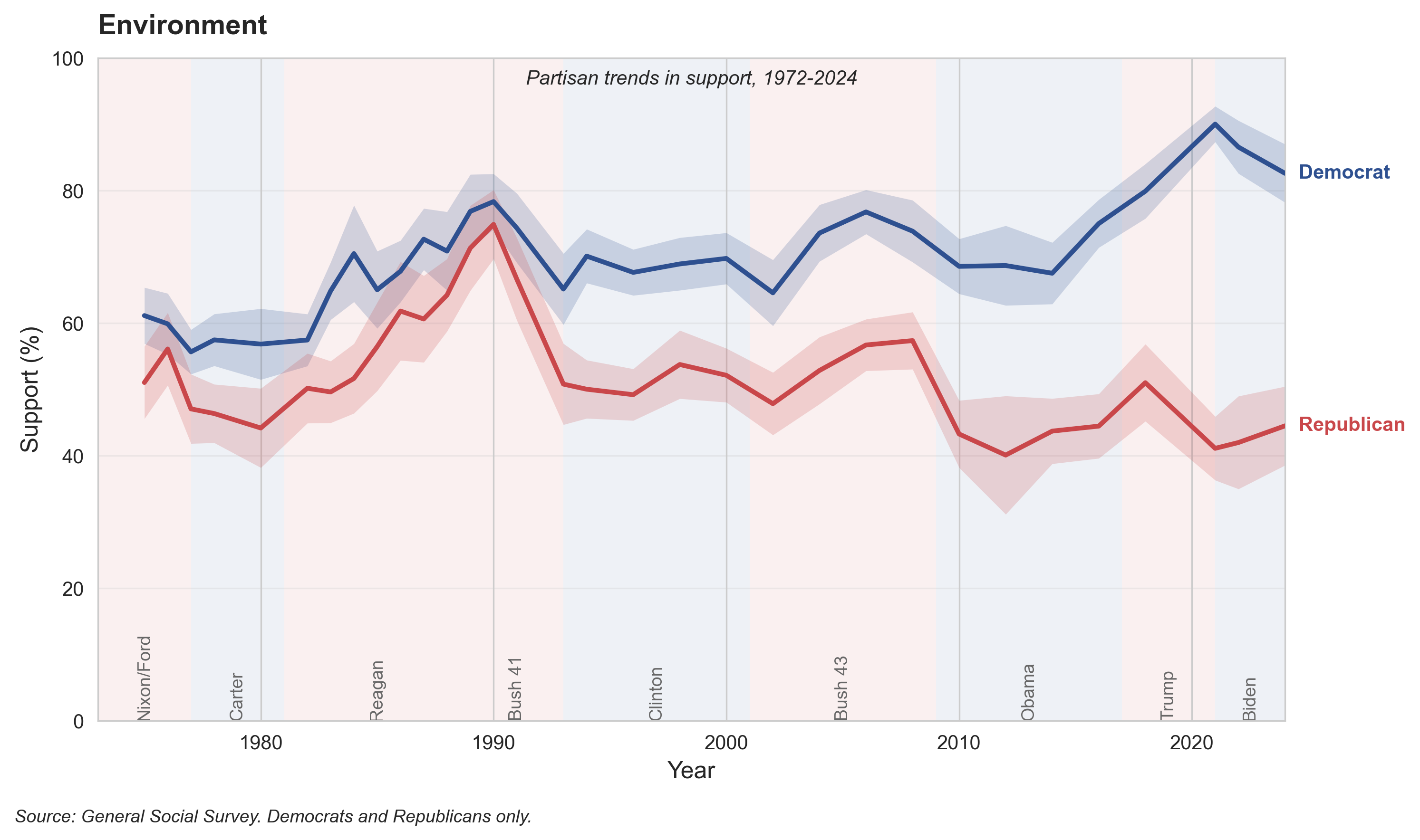
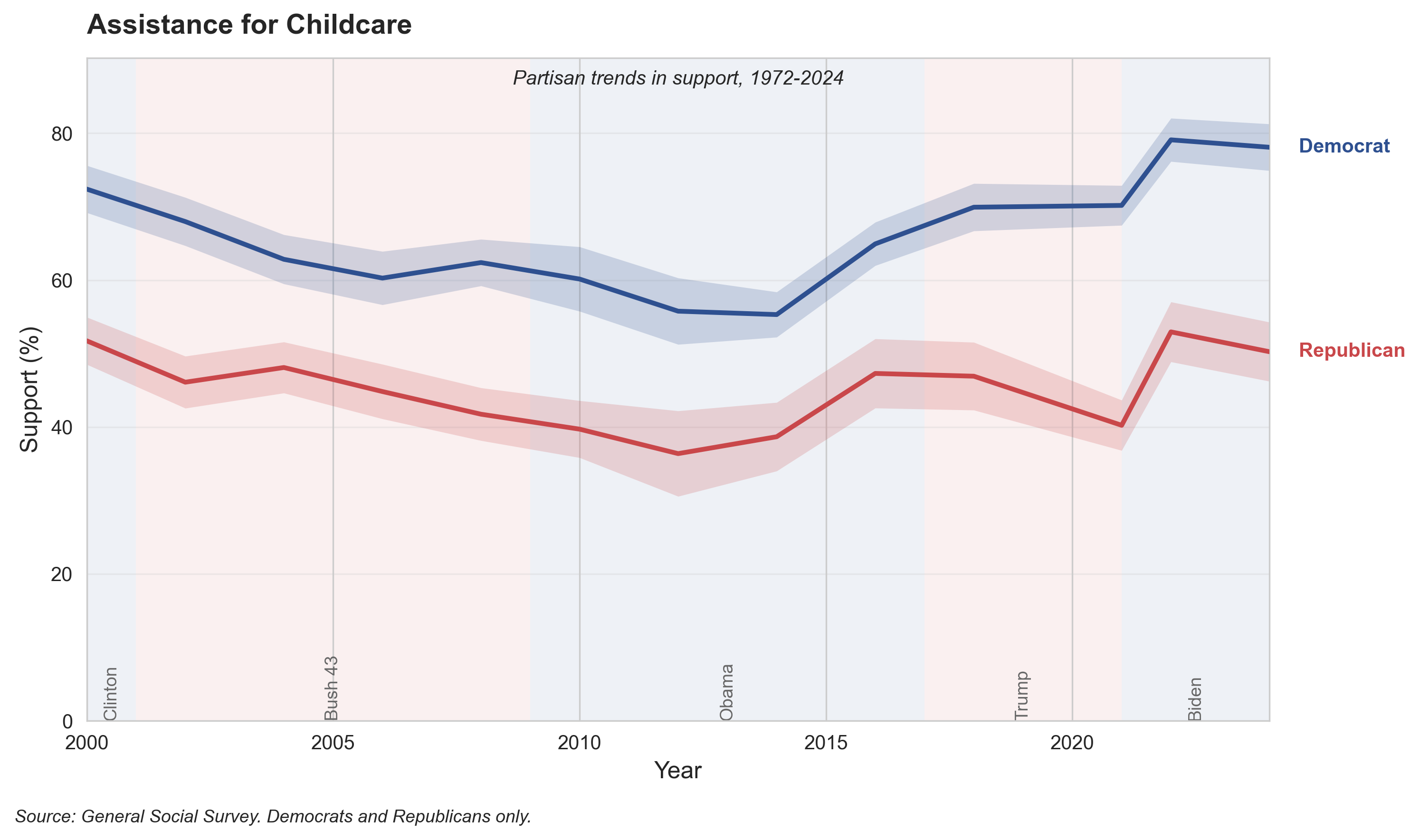
Not all spending priorities show extreme polarization. Environmental spending (Figure 6) and childcare assistance (Figure 7) reveal moderate but growing divides.
Environmental spending was relatively bipartisan through the 1980s, with both parties showing similar (and rising) support. The divergence began in the 1990s and accelerated in the 2000s. By 2024, Democrats are roughly 25 points more likely than Republicans to say we spend too little on the environment—a substantial gap, but smaller than race or welfare.
Childcare shows a different pattern: rising support among both parties, but Democrats rising faster. This suggests an issue where partisan sorting is occurring, but around a generally favorable trend rather than absolute opposition.
Low Polarization: Infrastructure and Health#
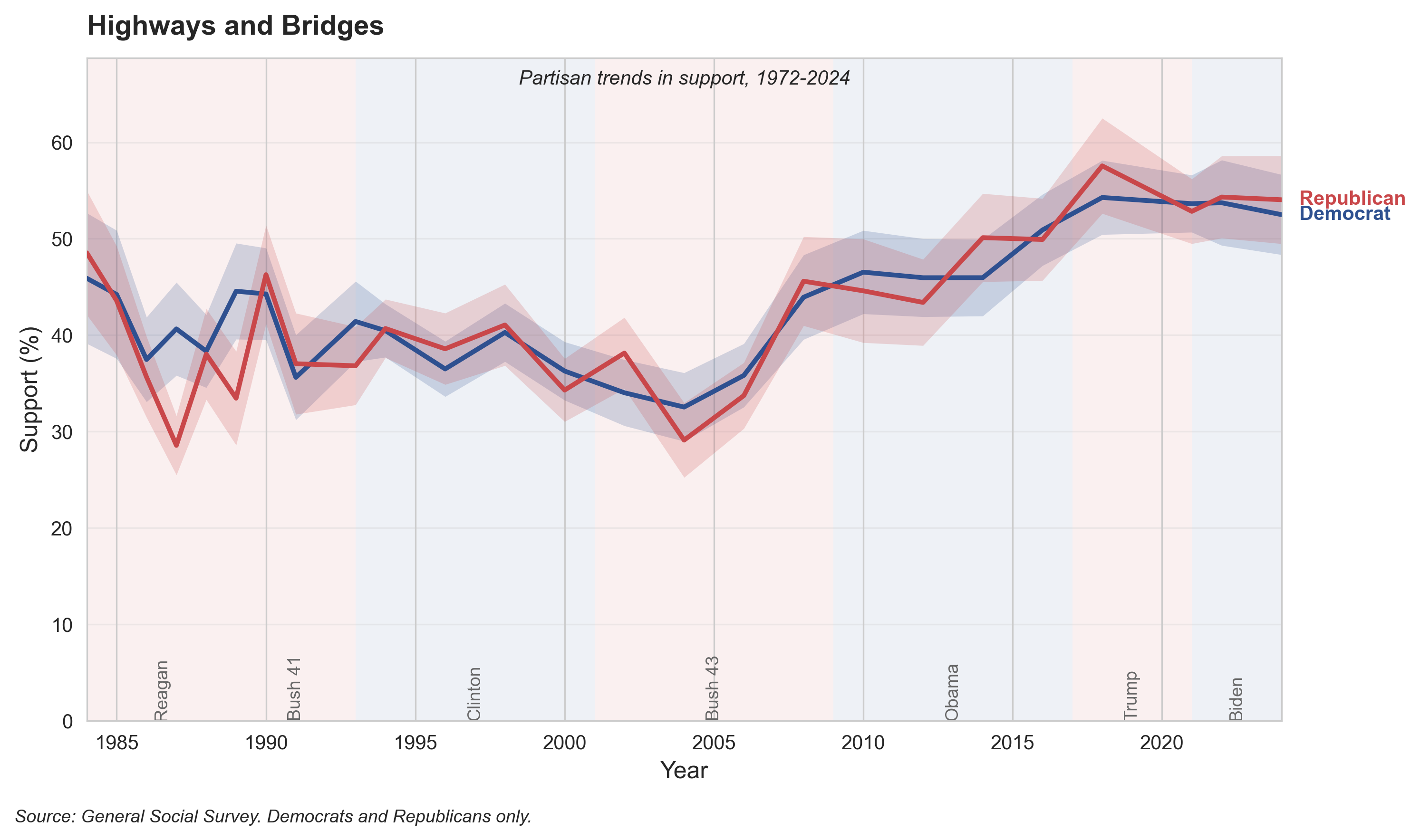
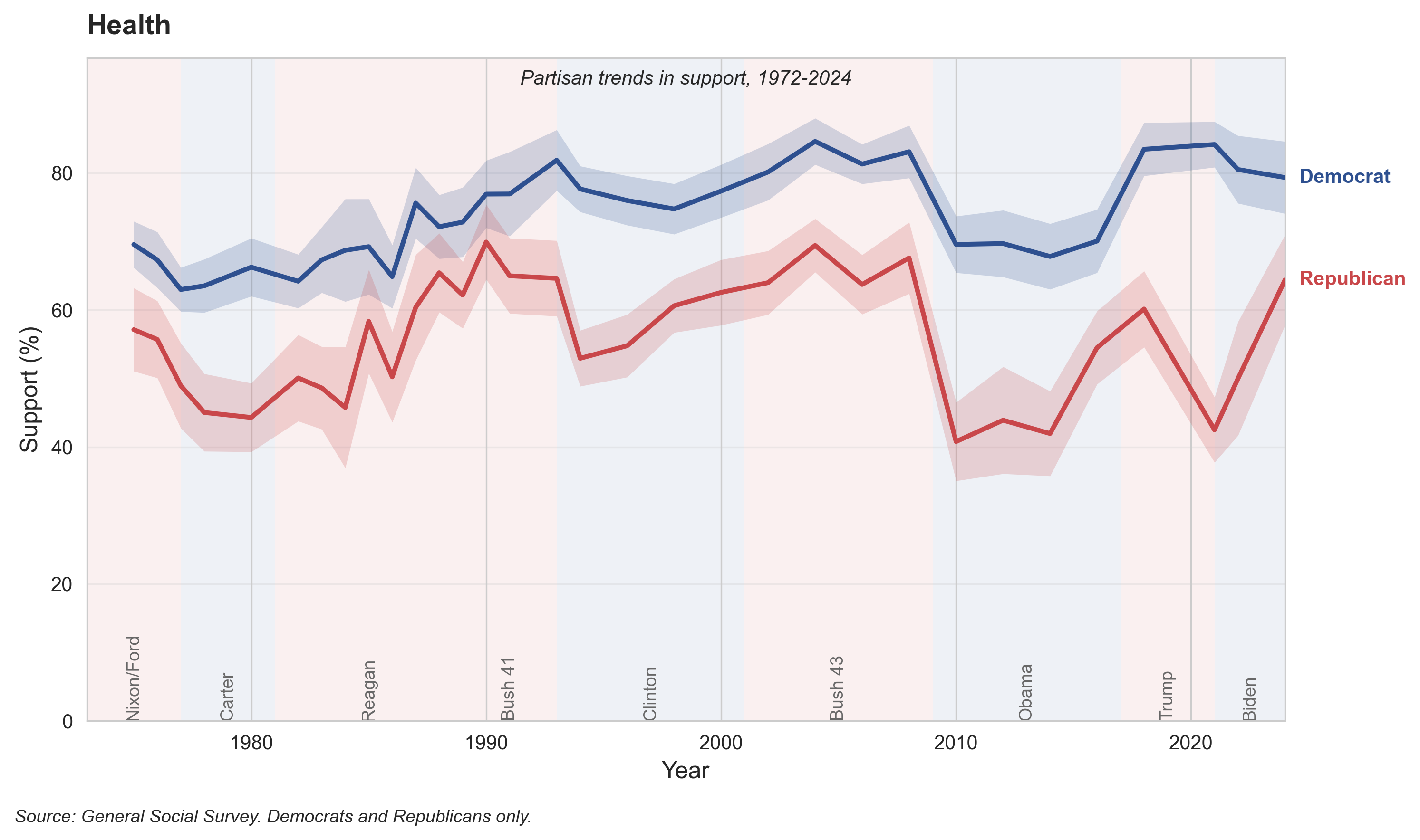
Some spending categories remain relatively bipartisan (Figures 8-9).
Infrastructure spending (highways, bridges) and health spending show persistent bipartisan agreement. Both parties want more infrastructure investment and health spending. These represent the rare contemporary examples of spending consensus.
4.The Philosophy Gap: Self-Reliance vs. Government Action#
Beyond specific programs, Americans disagree about government's fundamental role. Should government help people in need, or should people help themselves?
Government Should Reduce Income Inequality#
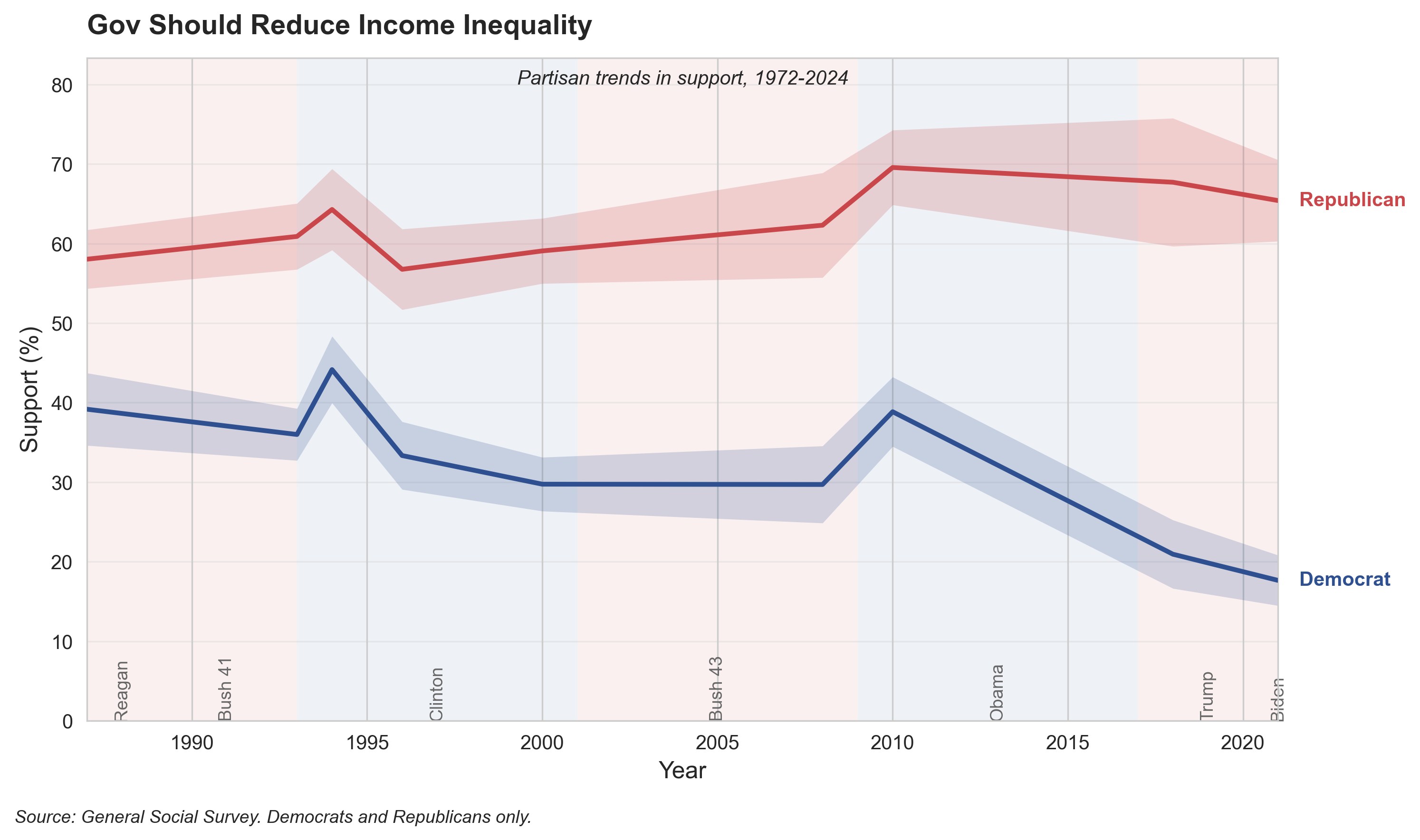
Figure 10 shows trends in support for government action to reduce income inequality—one of the starkest philosophical divides.
In the 1970s and 1980s, majorities of both parties agreed government should reduce income inequality. By 2024, this consensus has shattered. Over 70% of Democrats believe government should act to reduce inequality, compared to under 30% of Republicans. This is not a question about a specific program—it's a question about whether government should pursue economic equality as a goal.
People Should Help Themselves#
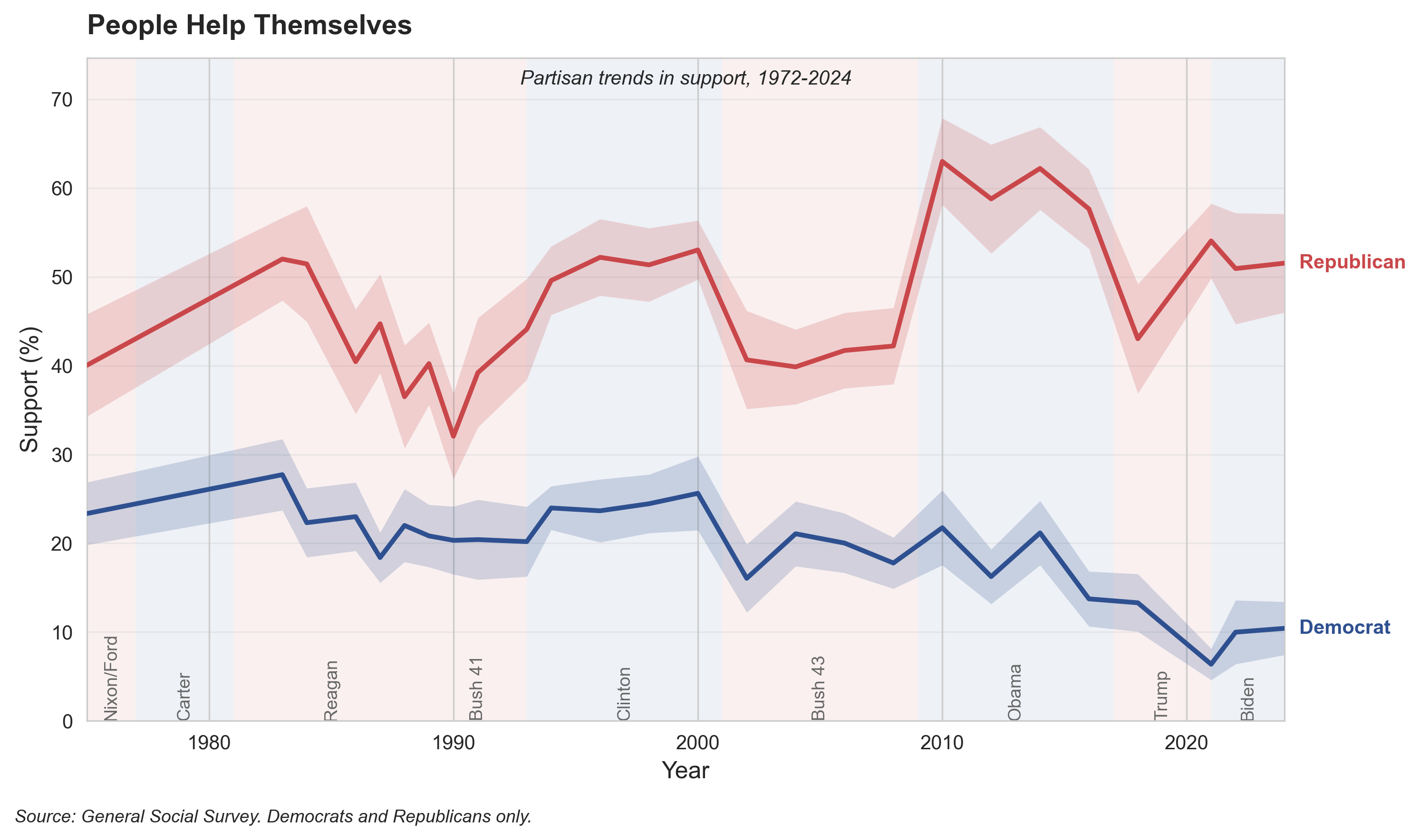
The flip side appears in Figure 11, showing agreement that "people should help themselves" rather than rely on government.
Republican support for the self-reliance principle has remained high and even strengthened, while Democratic support has declined. This creates a philosophical chasm: Republicans increasingly believe people should solve their own problems, while Democrats increasingly believe government should help.
Government Should Help the Poor and Sick#
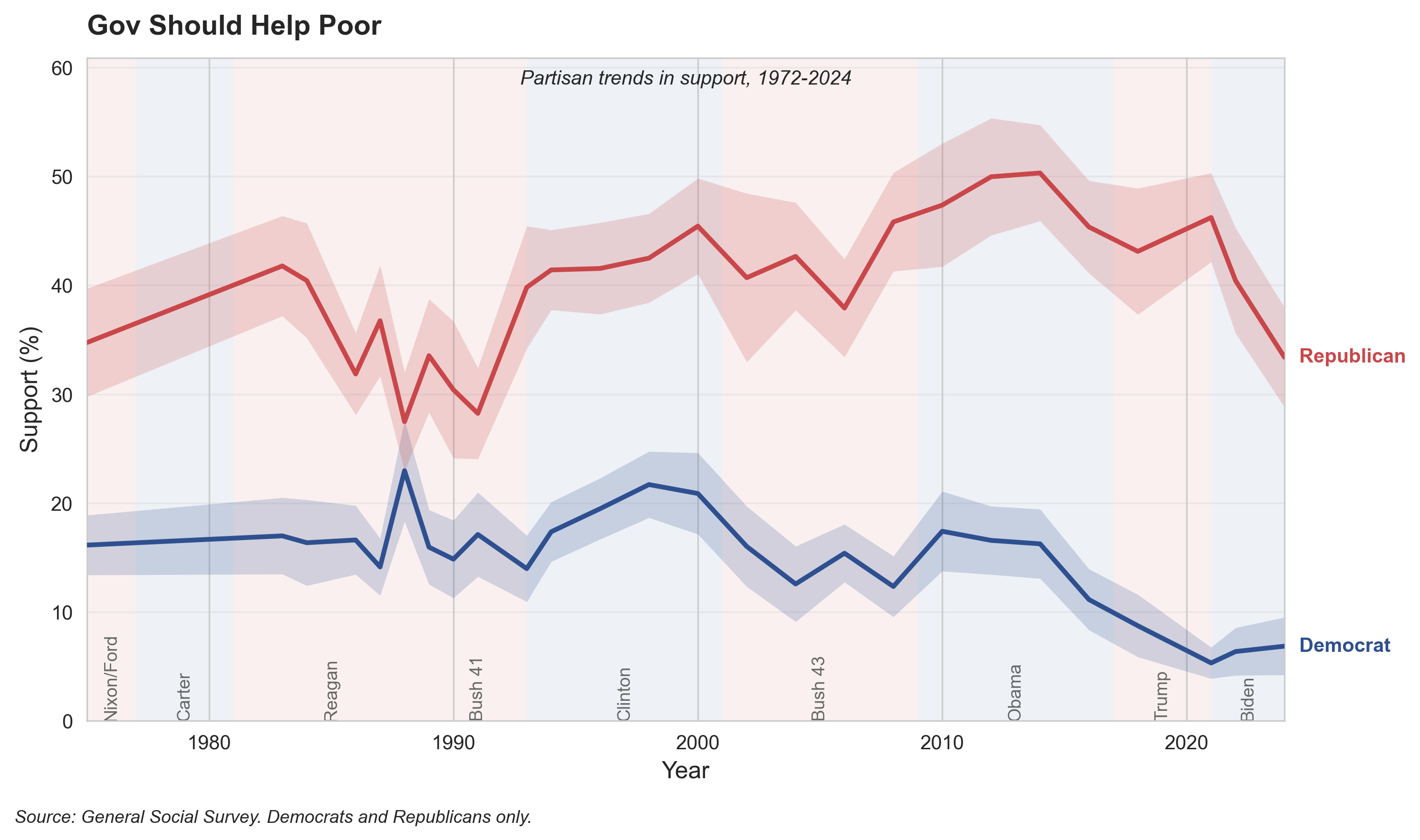
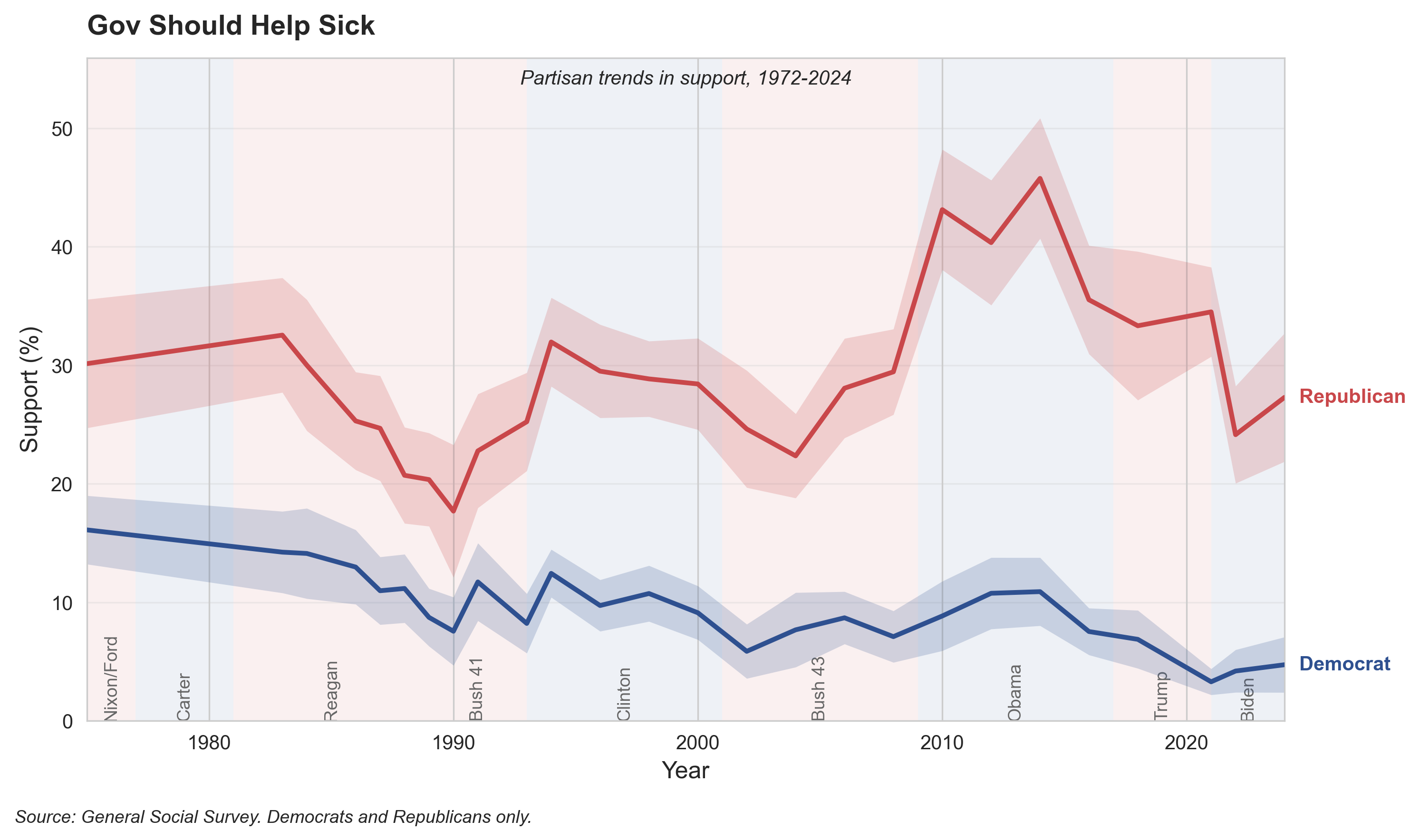
Figures 12-13 show support for government assistance to specific groups: the poor and the sick.
Even on helping the sick—something that might seem universally sympathetic—partisan gaps have emerged. While both parties still show majority support, Democrats are substantially more supportive than Republicans. On helping the poor, the gap is even larger.
5.Education and Political Eras: The Amplification Story#
The spending divide is not uniform across demographic groups or time periods. Education level dramatically shapes partisan differences, with college graduates showing the widest gaps.
The Race Divide by Education#
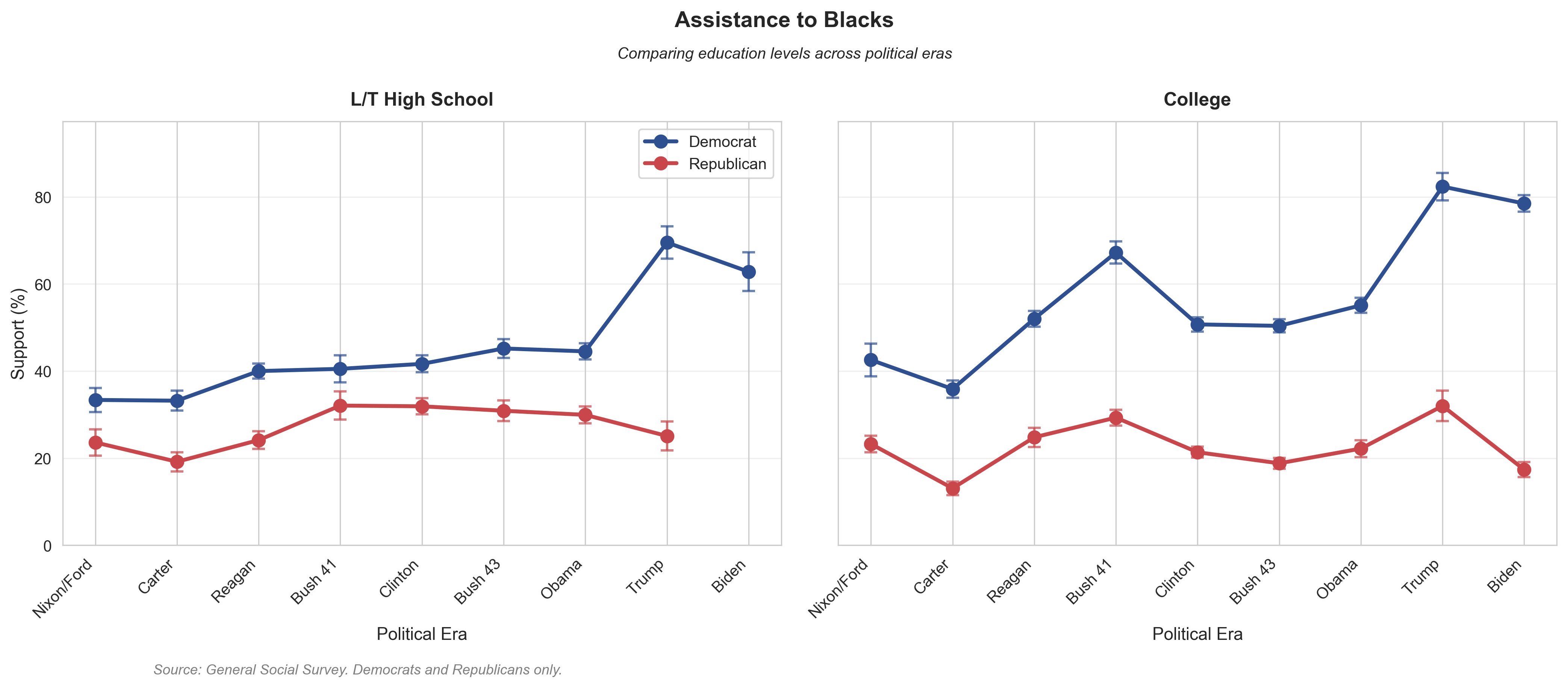
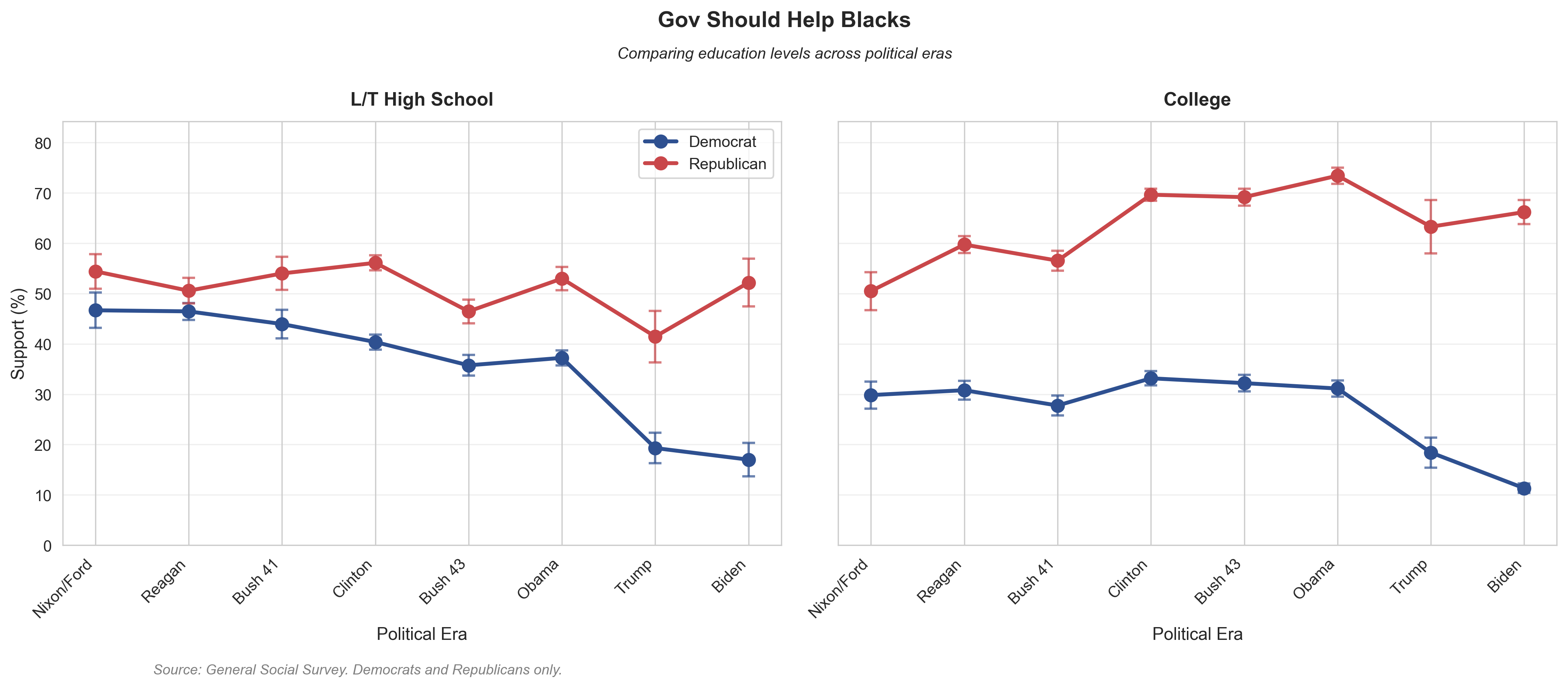
Figure 14 shows support for increased spending on assistance to Blacks, broken down by education level across political eras.
Among college graduates, the partisan gap on racial assistance is enormous—often exceeding 50 percentage points in recent eras. Among those without high school degrees, the gap is smaller (though still substantial at 20-30 points). Education doesn't just predict views—it magnifies partisan differences.
Welfare and Income Inequality by Education#
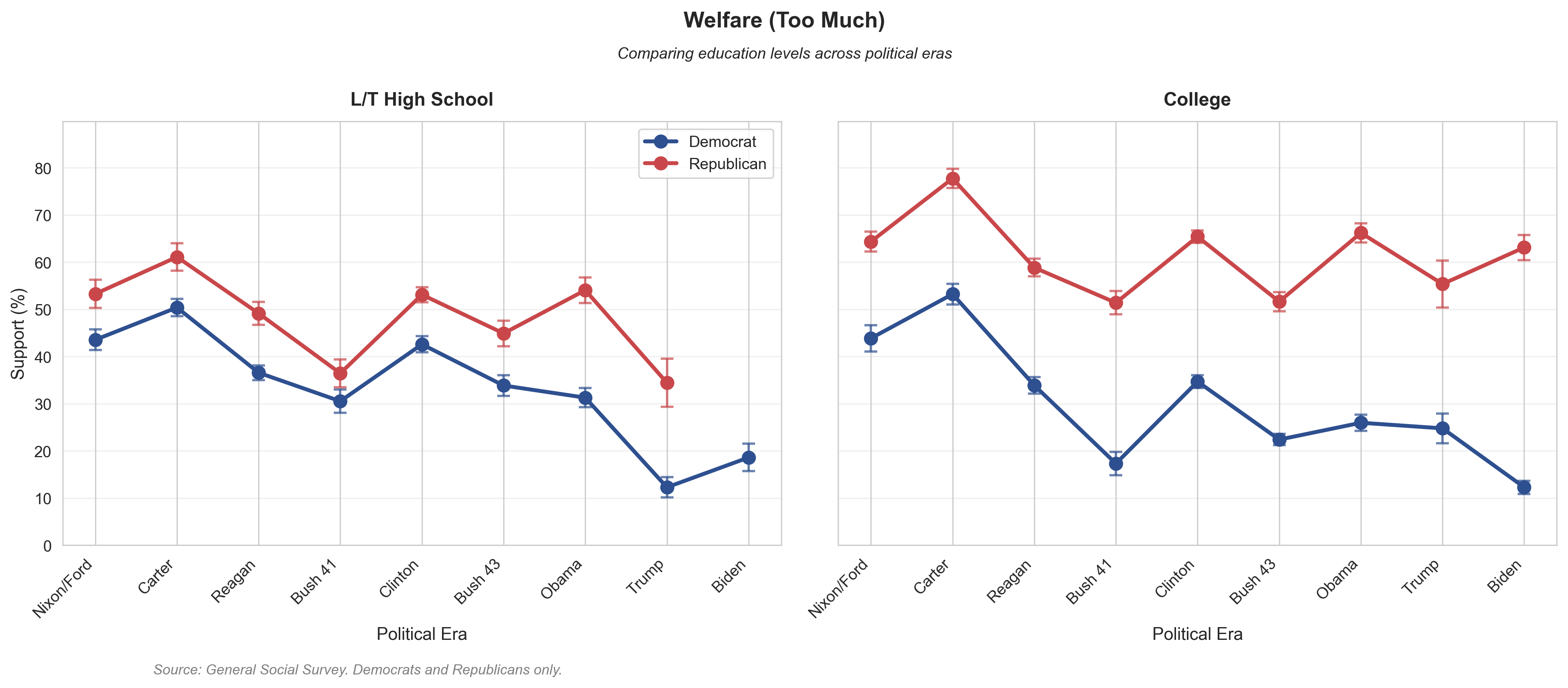
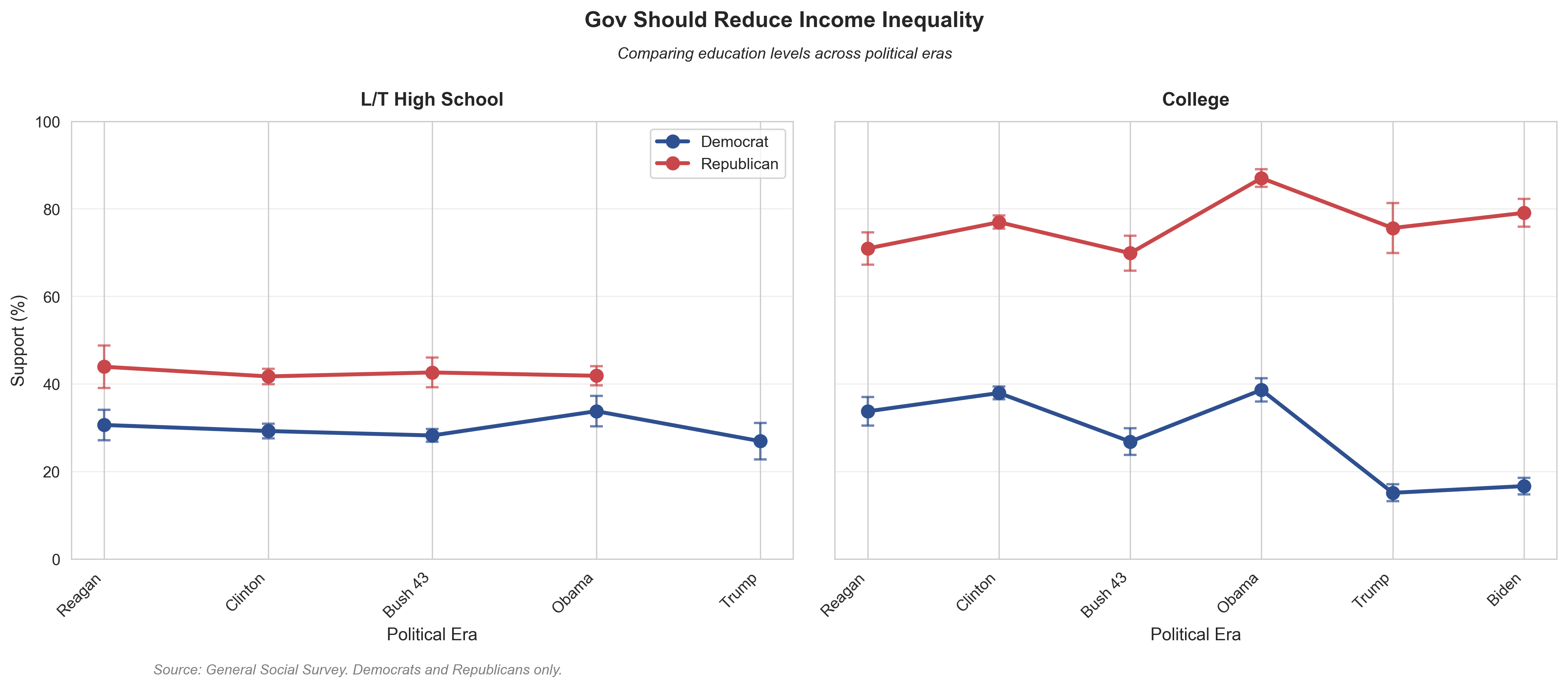
The education amplification pattern holds across redistributive issues (Figures 15-16).
College-educated Republicans are the most concerned about "excessive" welfare spending and the least supportive of income redistribution. College-educated Democrats show the opposite pattern. This educational sorting suggests that partisan polarization is strongest among those with the most formal education—the very group often assumed to be most "informed" or "rational" in their political views.
The Education Paradox
Higher education doesn't reduce partisan polarization—it amplifies it. College graduates are *more* polarized than those without degrees on most spending issues. This challenges conventional wisdom that education promotes consensus.
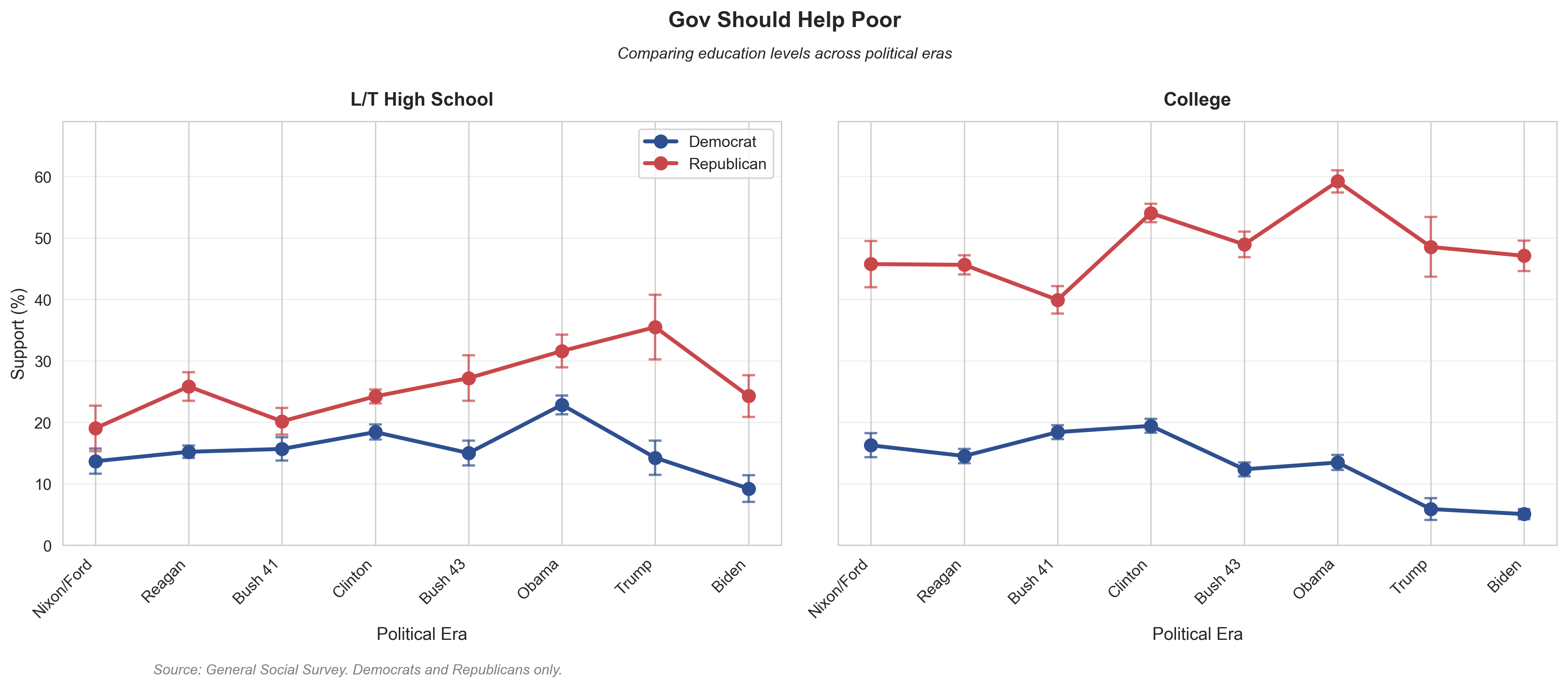
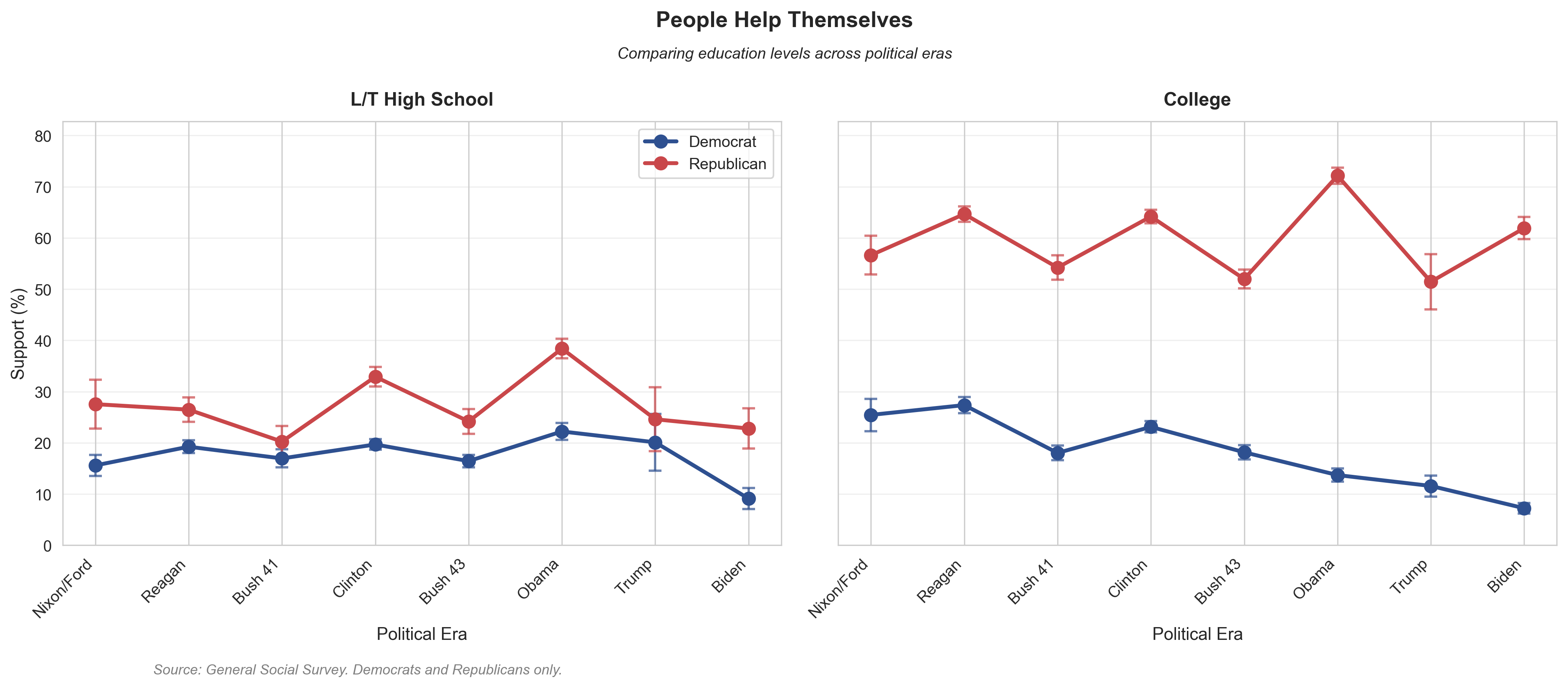
Government Help vs. Self-Reliance by Education#
Figures 17-19 show how education shapes fundamental views about government's role.
The pattern is consistent: on philosophical questions about government's role, college-educated partisans diverge most sharply. This suggests that education provides not just information, but frameworks and identities that reinforce partisan divides.
6.Defense, Crime, and Law & Order: The Republican Advantage#
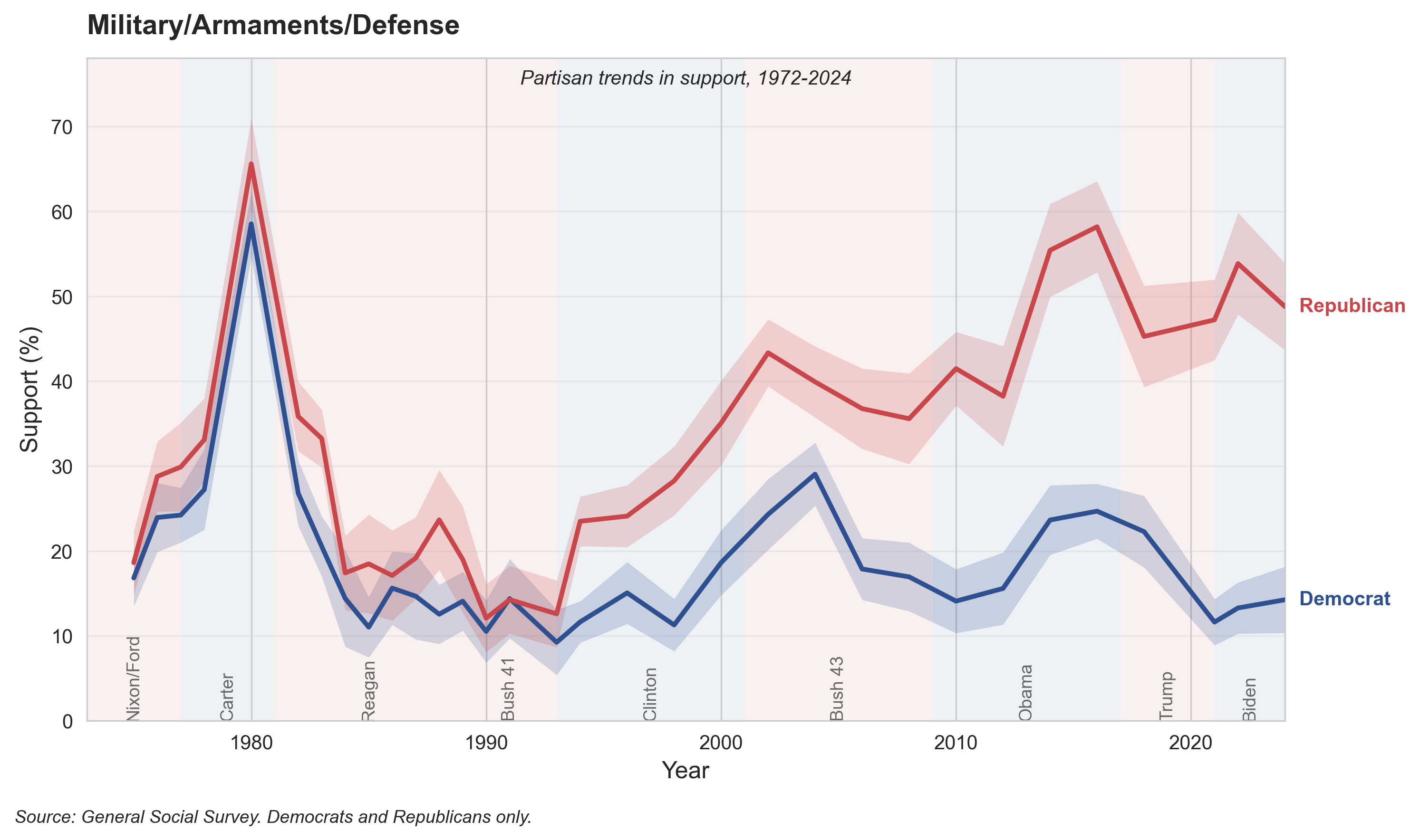
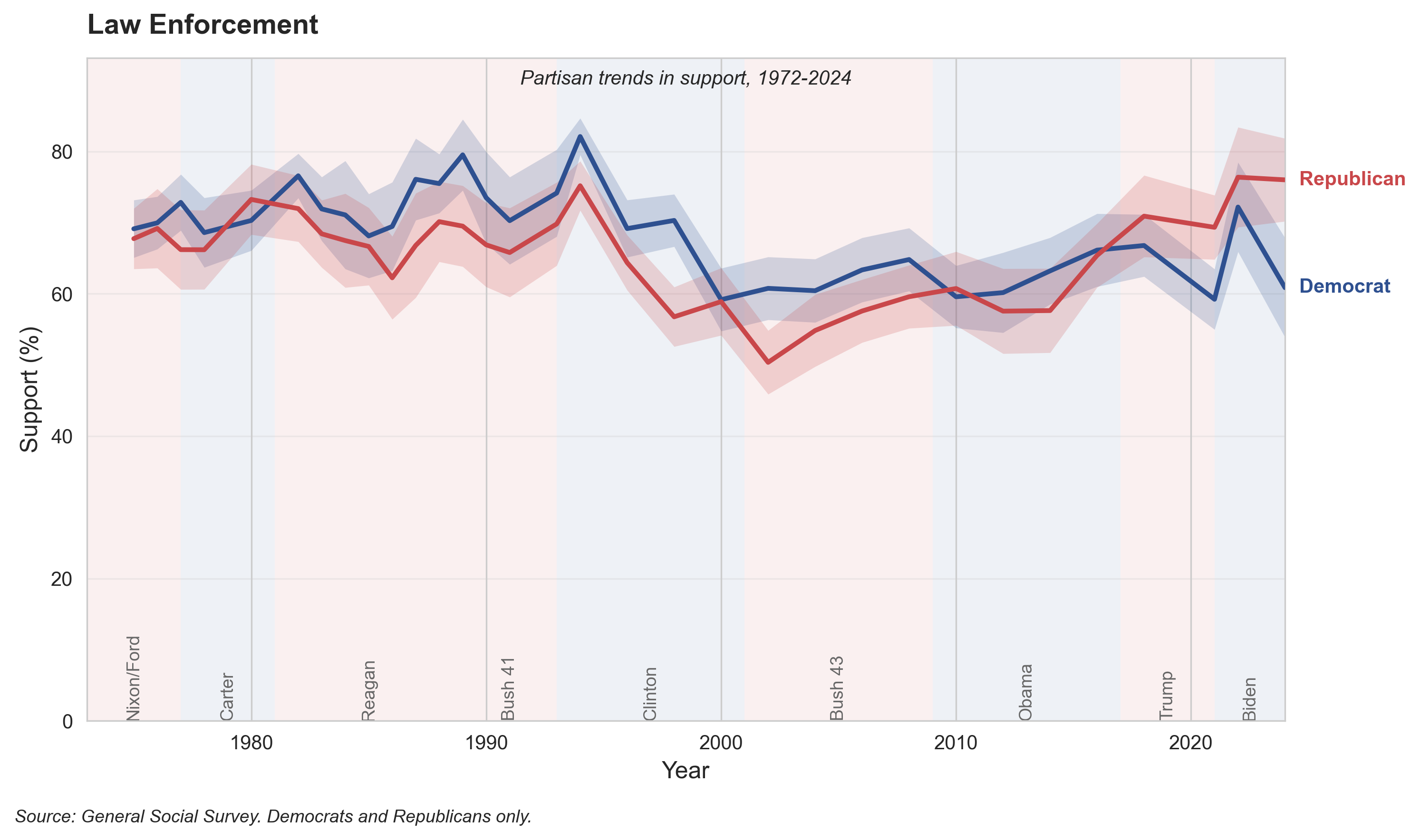
While Democrats favor more spending on most social programs, Republicans show stronger support for defense and law enforcement spending.
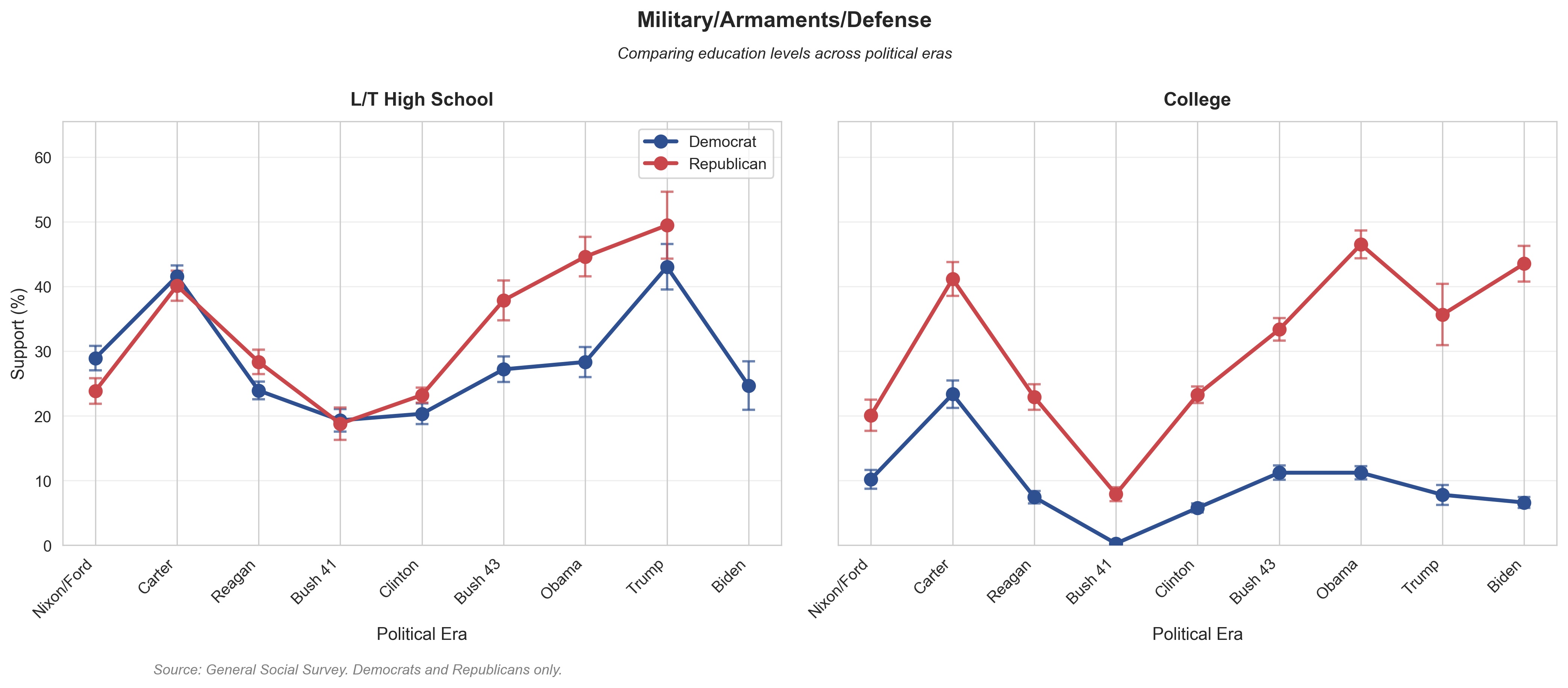
Defense spending shows the inverse of welfare: Republicans are more likely to say we spend too little, Democrats less so. The gap has varied over time—narrowing after 9/11, widening again in the 2010s—but Republicans consistently favor higher defense spending.
Law enforcement spending shows a similar but more muted pattern. Both parties support more spending on crime prevention, but Republicans support it more strongly. This gap has widened in recent years, possibly reflecting debates over policing and criminal justice reform.
The education amplification pattern holds even for defense spending. College-educated Republicans are the strongest supporters of military spending; college-educated Democrats are the least supportive. Once again, education doesn't moderate—it polarizes.
7.Science, Education, and Social Services#
Some spending categories don't fit neatly into "liberal" or "conservative" frameworks, yet still show partisan divides.
Education Spending: Moderate Divide#
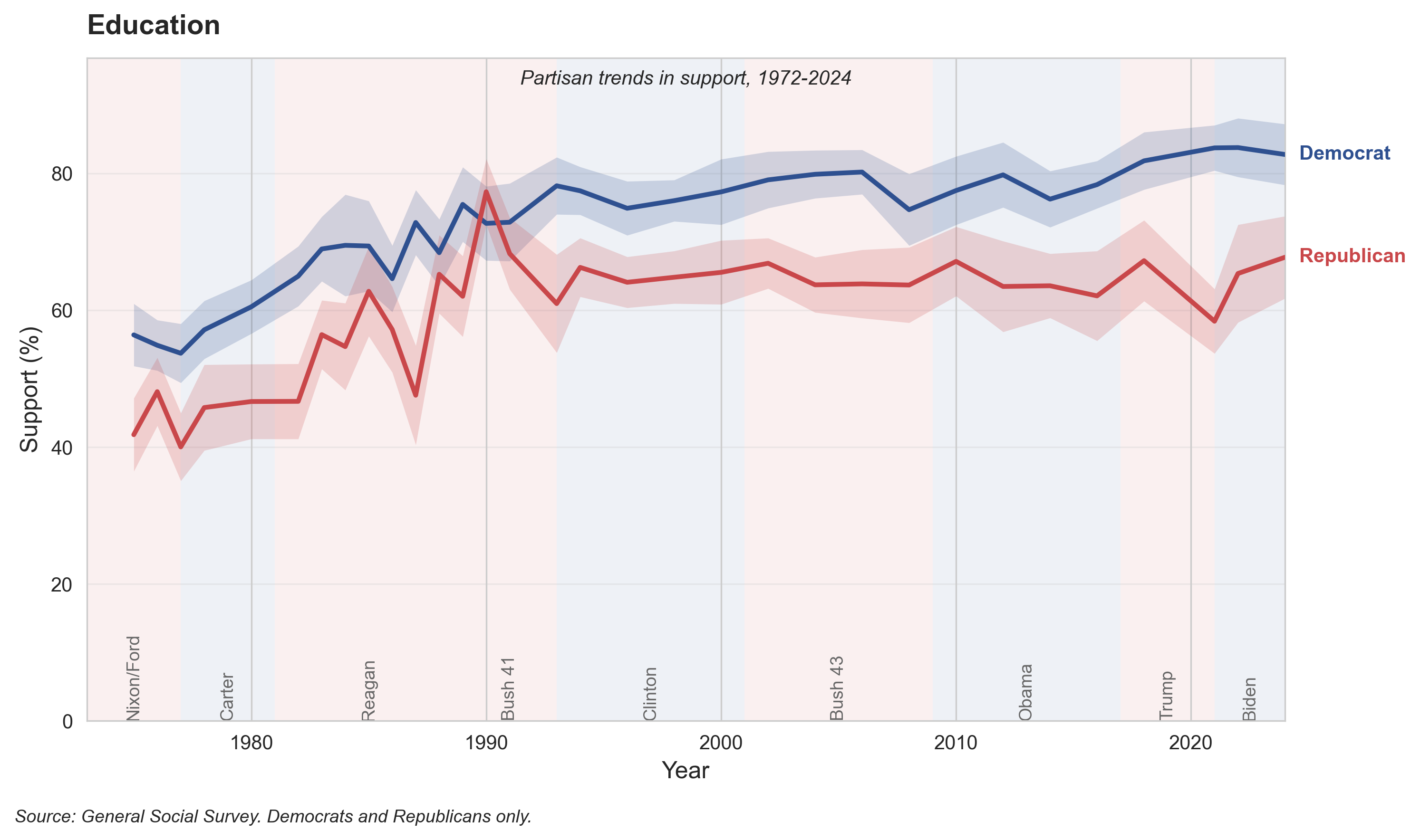
Education spending shows moderate polarization. Both parties support more education funding, but Democrats support it more strongly. The gap has grown over time, from roughly 10 points in the 1970s to 20+ points in recent years.
Scientific Research: Emerging Divide#
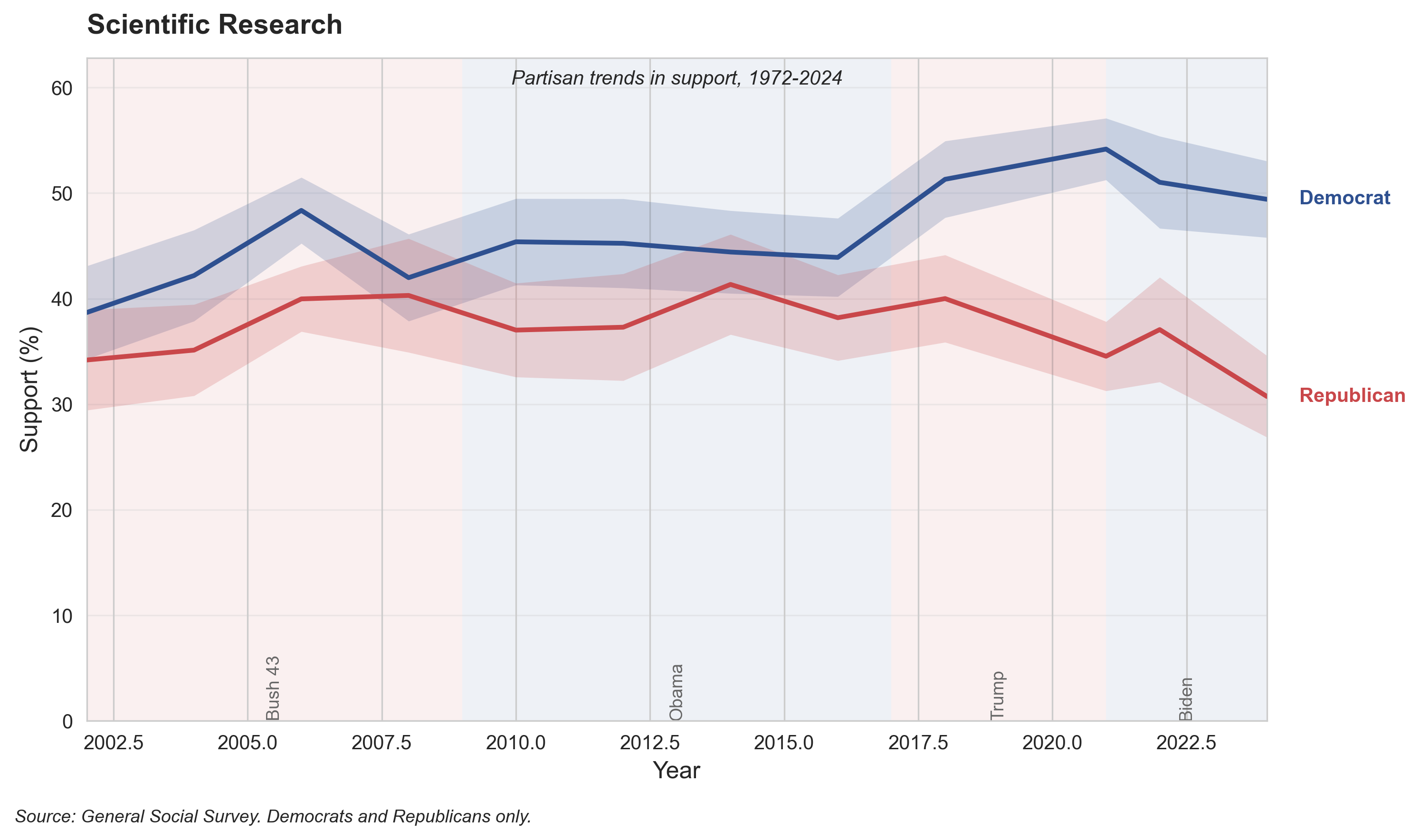
Scientific research spending reveals an emerging divide. Through the 1990s, both parties showed similar support for science funding. Since 2000, Democrats have become more supportive while Republican support has flatlined or declined slightly, creating a modest partisan gap.
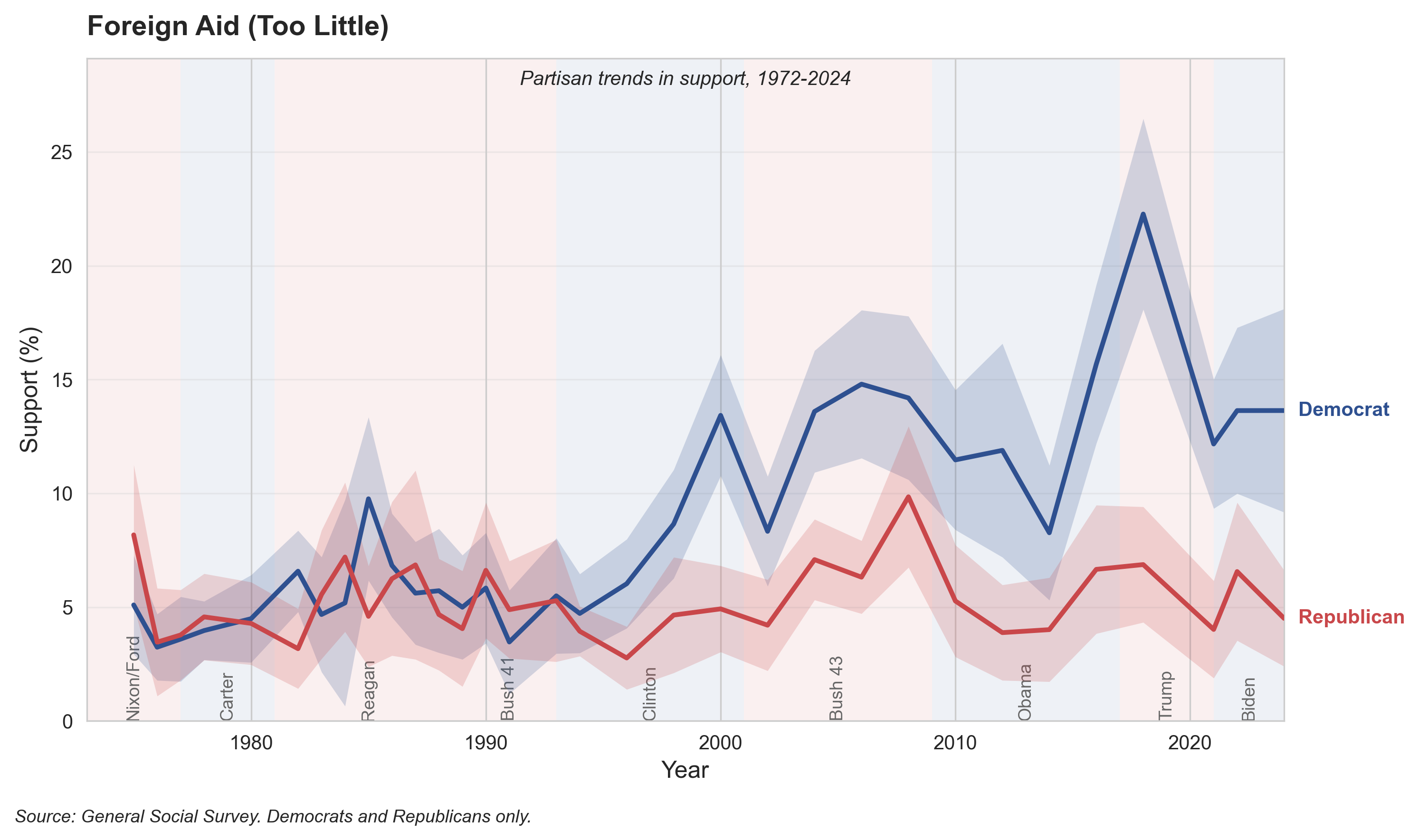
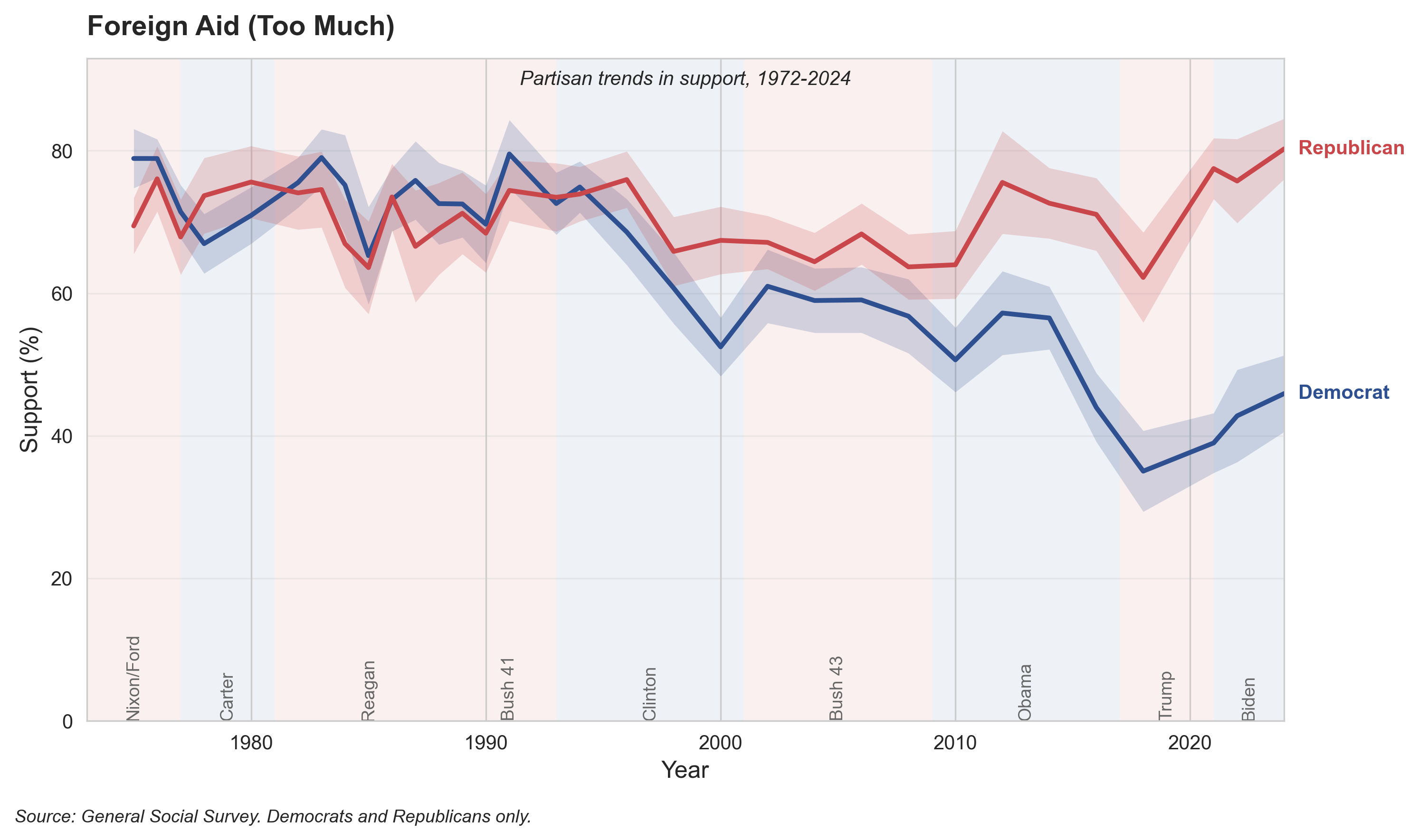
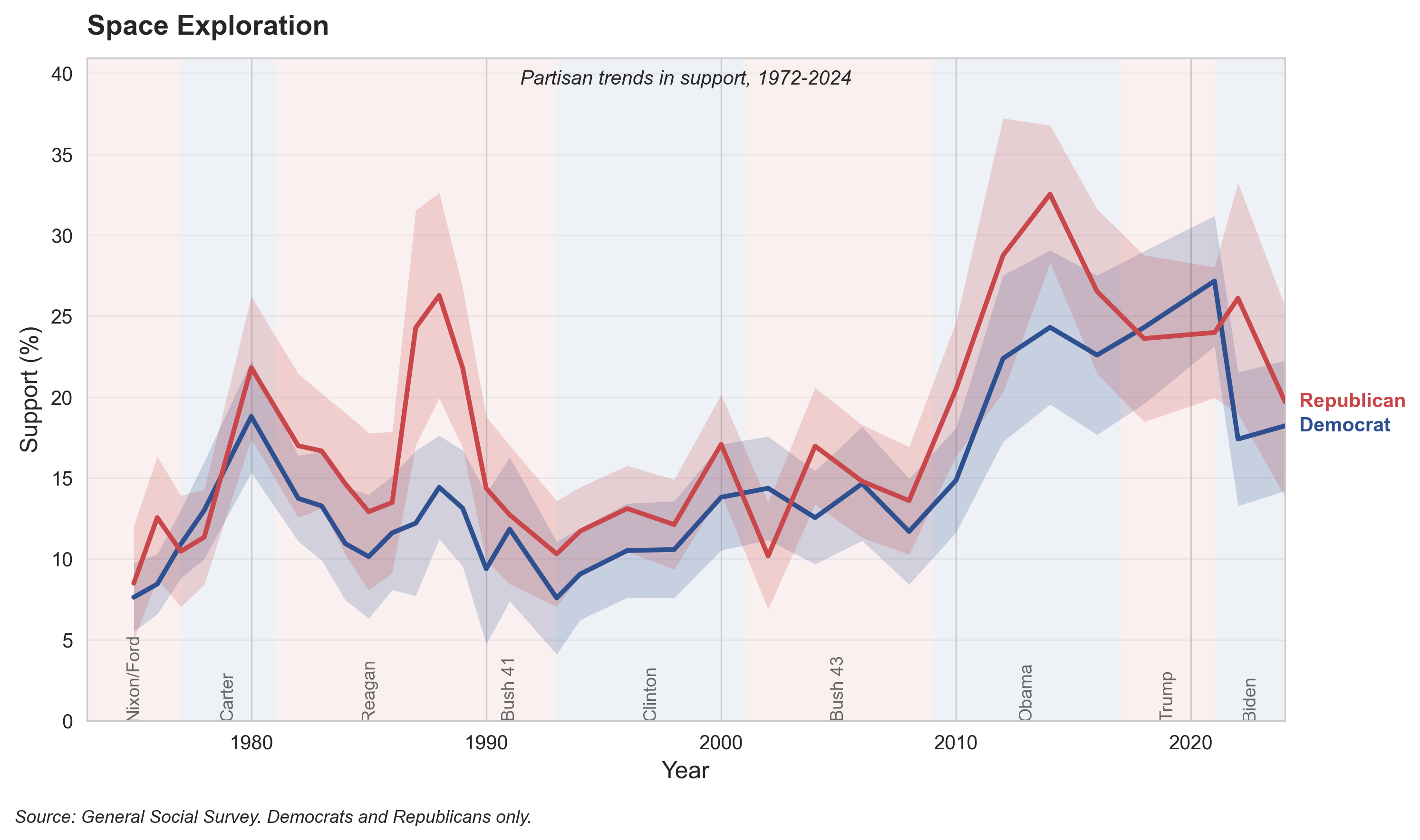
8.Foreign Aid and Space: Low Priority, High Polarization#
Some spending categories receive little support from either party but still show partisan divides.
Foreign aid is deeply unpopular with both parties. Large majorities say we spend too much; very few say we spend too little. Yet even here, partisan gaps exist: Republicans are more likely to say we spend too much, Democrats slightly less so.
Space exploration shows declining support from its Apollo-era peak. Both parties have grown less enthusiastic, but Democrats have declined more, creating a small Republican advantage. Still, neither party shows majority support for increased space spending.
9.Discussion and Implications#
Three Key Findings#
Our analysis of five decades of spending preferences reveals three central patterns:
The Spending Divide in Context#
The spending divide is not an isolated phenomenon—it reflects broader partisan sorting in American politics. Just as we've documented elsewhere in this project, partisans have sorted into opposing camps on abortion rights, institutional confidence, and social trust. The budget debate is simply another domain where partisan identity now predicts policy preferences with high accuracy.
Yet spending preferences may be especially consequential. Unlike abortion (where state-level policy variation is possible) or institutional confidence (which is mostly expressive), federal spending requires collective decisions. We have one federal budget, not fifty state budgets. Partisan polarization on spending translates directly into legislative gridlock, government shutdowns, and fiscal brinkmanship.
The Gridlock Connection
When parties disagree by 40+ points on whether to increase spending on racial programs or reduce income inequality, finding compromise becomes nearly impossible. The spending divide helps explain why budget negotiations have become increasingly contentious and why government shutdowns have become routine political theater.
Limitations and Future Directions#
Our analysis has limitations. First, GSS questions use fixed wording that may not capture evolving program realities. "Welfare" means different things in 1975 and 2024. Second, we measure *preferences* for spending, not actual fiscal impact. A large percentage gap on foreign aid (1% of the budget) matters less than a small gap on Social Security (20% of the budget). Third, our education analysis cannot fully disentangle educational attainment from income, occupation, or geography—all correlates of both education and partisanship.
Conclusion#
The American spending divide is wide, growing, and multidimensional. Democrats and Republicans disagree not just about how much to spend, but about what to spend it on and whether government should be spending at all. These disagreements are sharpest among the college-educated—the group most likely to vote, donate, and hold political office.
The fiscal implications are profound. In a democracy, sustained government programs require sustained public support. When half the country views programs as essential and half views them as wasteful, maintaining those programs becomes politically precarious. The spending divide thus threatens not just fiscal policy, but the stability of the American welfare state itself.
More fundamentally, the spending divide reflects diverging visions of America. Should we be a nation of shared fate and mutual obligation, or individual striving and personal responsibility? Should government actively reduce inequality, or allow market outcomes to stand? These are not technical questions about optimal spending levels—they are foundational questions about national identity and purpose.
The spending divide suggests that partisan conflict is not a temporary aberration or communication failure. It reflects genuine, deeply held differences about the kind of society we want to build. Bridging this divide will require more than better budget spreadsheets. It will require Americans to grapple with fundamental questions about fairness, opportunity, and the social contract.
10.Data and Methods Appendix#
[object Object]
Social Security: Bipartisan but Declining#